
Build an irreplaceable mind with a commonplace book
A simple pen-and-paper system for building taste and forming your own thoughts about what you read.
I saw it again. New research says AI is making us all think alike.
Yes, it sounds scary. Yes, it feels like AI is the first technology to really make us all dumb.
In reality, we’re simply re-encountering an old struggle layered with new tech:
Regularly exercising our deep thinking muscles.
Even before AI, we amass ideas in our Notes app, only to have it become an idea graveyard.
The micro-learning trend has weakened our ability to learn from reading actual books.
The pull to engage superficially with ideas is so strong now.
What hasn't changed is the hard work required to think distinctively:
Immersing yourself in great ideas
Thinking deeply about those ideas
This is why I'm returning to an old practice used by history’s greatest thinkers to slow down and engage deeply with the ideas once again.
It’s called a commonplace book.
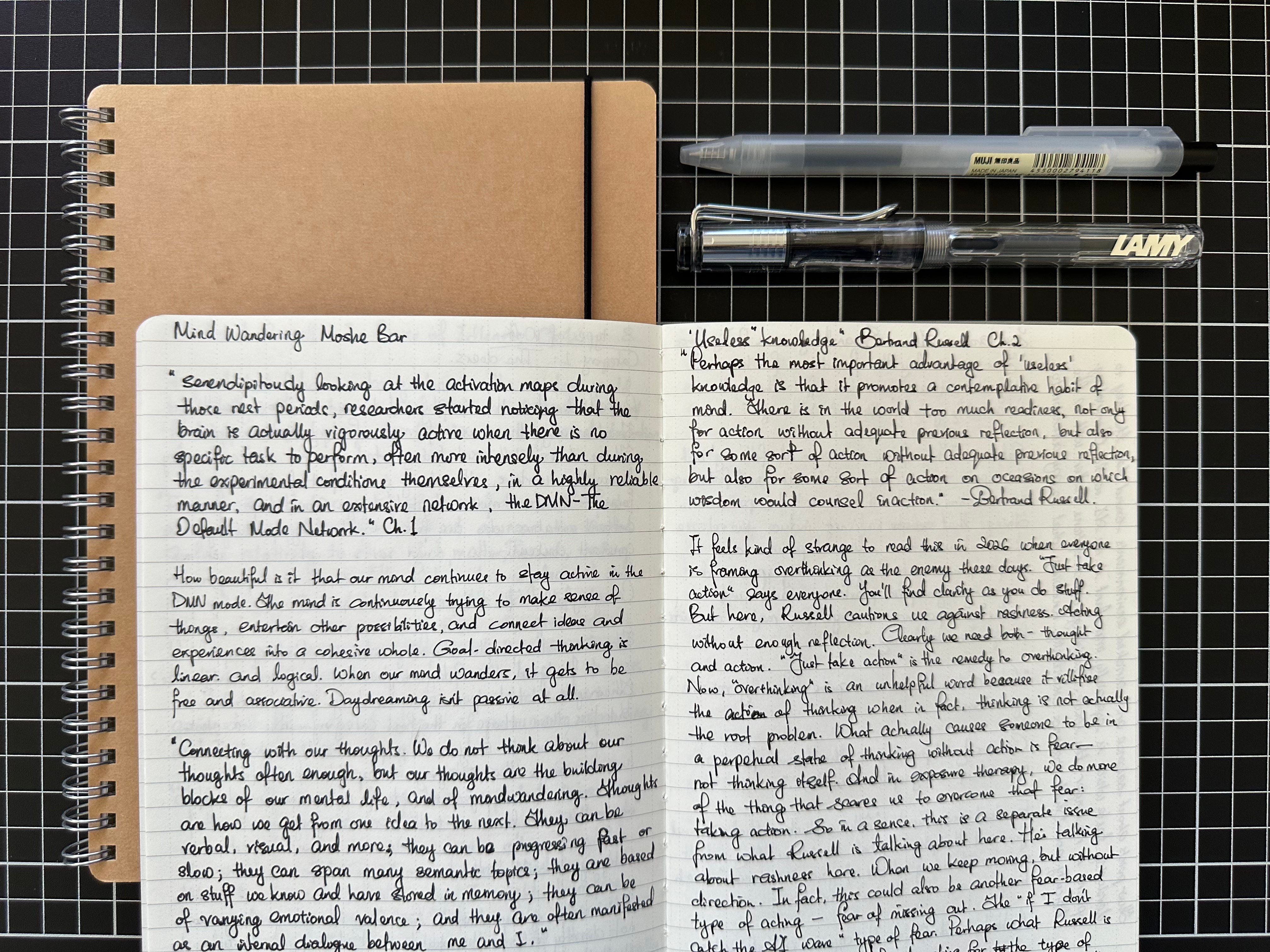
What is a commonplace book? (A journal of ideas)
Unlike a traditional diary, where you would write about your feelings or the events of the day, a commonplace book is a notebook for collecting interesting information or ideas.
It can be things like quotes from books and articles, poems, or song lyrics.
Many of history’s greatest minds (from Marcus Aurelius to Virginia Woolf) used commonplace books to capture ideas that spoke to them.
Think of this as your personal museum of things you find interesting.
Or, an analog version of a “second brain” that’s less goal-directed and more inspiration-based. (I’ll go into digital and analog later).
It involves 3 simple steps:
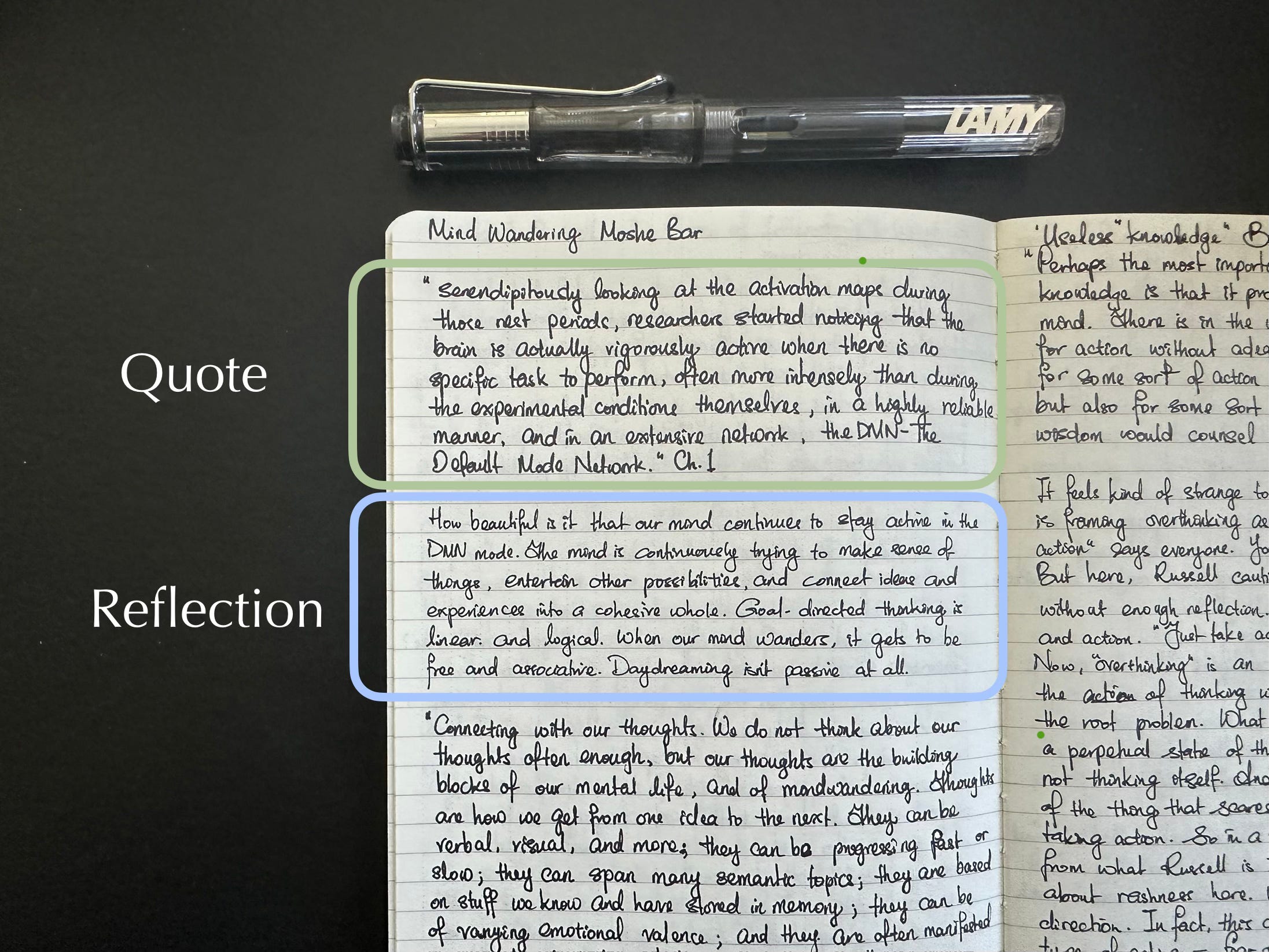
Expose yourself to great ideas: You come across an idea that captures your attention (a book quote, a tweet, something you heard in a podcast).
Write it down: Copy the quote or idea into your commonplace book.
Reflect: Add a micro-reflection that turns that idea into something that’s yours. It can just be a few short sentences.
My workflow: A digital + analog hybrid
“Nobody has time to write everything by hand” is something I relate to greatly.
Going 100% analog is a recipe for quitting.
I had a commonplace book in my college days (over a decade ago!), and moved to collecting ideas digitally for convenience.
I believe the way forward isn't choosing one or the other.
This is why I now have a hybrid system to harness the volume of digital while retaining the depth of analog:
Wide digital capture (Notion): This is where I make a quick initial capture of the quote, add a brief note about why it spoke to me, and then file it under a theme. (I like YouTuber Robin Waldun's system).
Deeper analog thinking (notebook): I migrate the ideas I love most from Notion to my physical notebook. When I write, I'm putting in extra effort. This forces me to be more intentional about the passages I select and how I think about the idea.
What's the point? To think more distinctively
Historically, the purpose of a commonplace book was to be both an information archive and a thinking tool.
But now, I see it more as a thinking tool.
We all probably already have some way of curating ideas digitally, which serves as a neater and more easily accessible archival system.
To me, the real benefit of writing out selected ideas by hand is that the effort leads to deeper and more distinctive thinking:
A different thinking environment: Swap the digital blank page for a physical blank page. There's less temptation to consult AI or Google for answers. You'd be surprised by what your brain comes up with when you sit alone with ideas for a while.
Stop losing great ideas: To have your own great ideas, you need to remember what you were inspired by. We’ve all had that “Eureka!” moment while reading, only to forget it two days later. When you write it down, you’re more likely to internalize and remember it. This is deep immersion in great ideas.
Writing makes your brain work differently: I never really believed the research floating around saying writing engages more parts of the brain than typing. But now that I've gone through periods of exclusive digital writing and am now returning to handwriting, I feel the difference.
Build your intellectual taste: You are the sole curator of your book. After a while, you’ll start to see a beautiful museum of artifacts you’ve collected over time. That's your intellectual taste emerging as you create a unique web of ideas.
The foundation for original ideas: To me, the most important aspect of a commonplace book are your reflections. Here, I don't aim for beautifully formed sentences. Just deeper logic that goes beyond paraphrasing. I try things like connecting it with other ideas, challenging the idea, or finding a different angle.
How to start (Forget “perfect”)
The only things you really need are: a notebook, a pen, and stuff you want to curate.
People get paralyzed by the “setup.” They buy a $30 notebook and then are too afraid to mess up the first page.
I was exactly like this and had a stack of unused notebooks.
The goal isn't to have a pretty or perfectly organized notebook.
It's meant to be an external, ever-evolving museum of your mind.
It's OK if it's messy.
Here are some other considerations for getting started, but there's no need to get bogged down by them.
Indexed by topic or messy? Traditionally, it’s meant to be indexed. But I think this matters less if you already have a digital way of capturing and organizing ideas. I go with messy.
Color-coded or plain? Some people like making a simple list of topics, with a color-coded sticker assigned to each. Then, you simply add a sticker to each entry. I think this is one of the easiest ways to organize things.
How should it go on a page? Experiment! Alternate between quote and reflection, write your reflections in the margins, or make it a double-column format with quotes on one side and reflections on the other. Play around and see what works for you.
To me, the two most important metrics for success are:
Will you actually do it? It’s got to be easy enough for you to stay consistent.
Does it make you think deeper? If your “system” is so complex that you’re more concerned with organizing than thinking, it's failed.
Is this something you'd try or are already doing? Let me know in the comments!
Most people stop at collecting ideas.
That’s why their thinking never compounds.
In the premium edition, I go deeper into the mental practices behind this:
How to synthesize ideas
Reflection prompts that turn notes into original insights
Upgrade to paid to build an irreplaceable mind.
Great calls going back to analog. Like your organization. Thanks for sharing this