
How to journal through the existential dread of living in the AI age
You stop looking for a cure and start developing your own relationship with it.
We hit 3K subscribers! As a big thank you, premium is currently 30% off for the month of July.
Every day you scroll past another headline about what AI is about to revolutionize, and you can’t shake the nagging dread underneath all the VC-backed optimism.
Sure, it’s convenient that something can shop for you, write your essay, think of an opinion to make you sound smart.
But what does any of this actually mean for you as a person? As a human being? The unsettling questions keep circling in your head.
Hey ChatGPT, will humans even be irrelevant in a few decades?
Why do I still feel so lonely even though I’m always connected?
Why am I exhausted when everything is meant to be more convenient and automated?
Why does it feel like technology is progressing by leaps and bounds, while the humanity it’s meant to serve isn’t?
On the surface, they all look like different worries. At the root, they're all pointing to questions of our human existence.
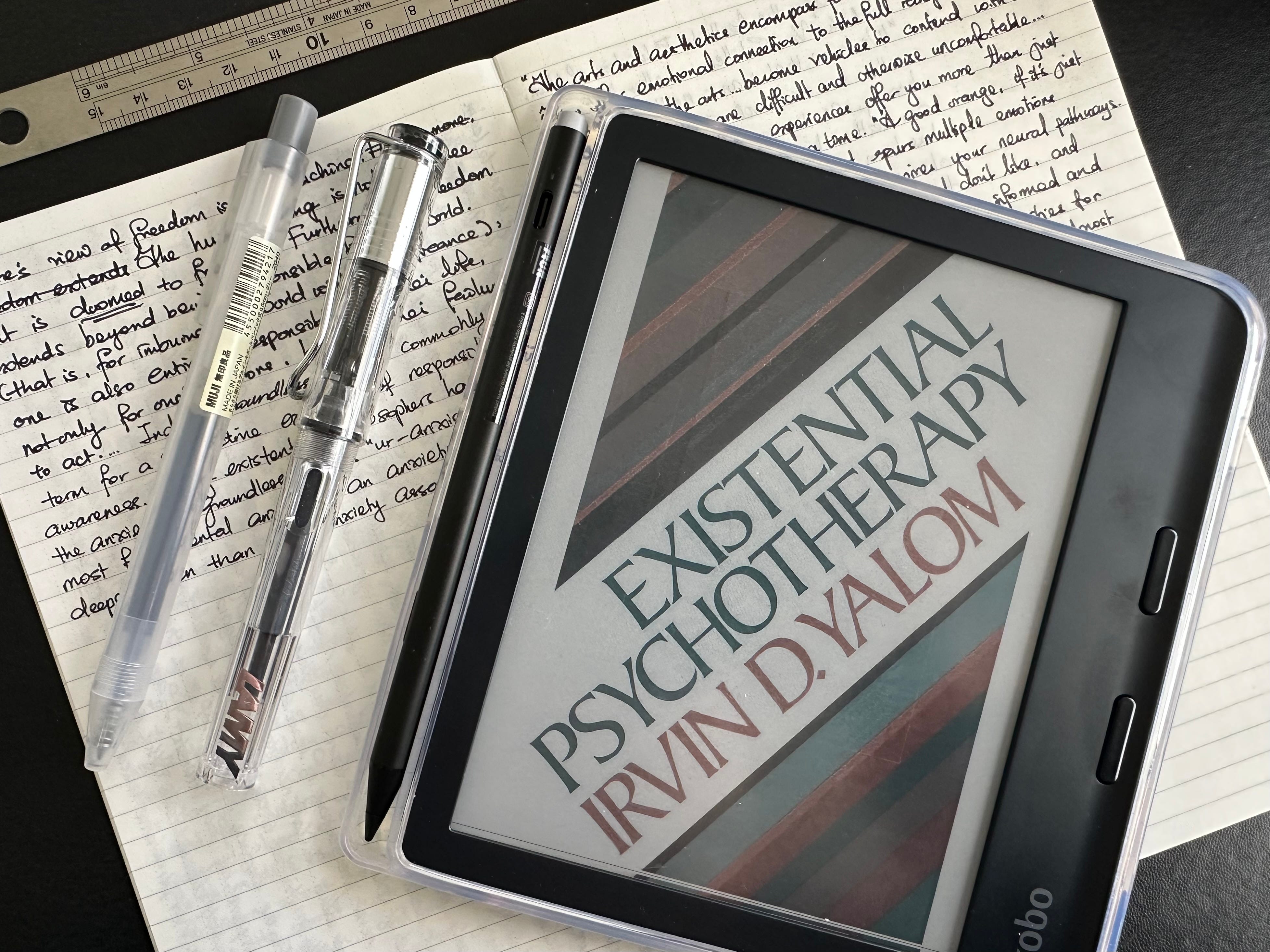
Why journal about this? (Not to write. To live.)
Because it’s one of the best ways to process this feeling. Every age has had its own confrontation with existential dread, usually spurred by whatever social, economic, or technological shift was disrupting life at the time. And humanity has always attempted to form its own conclusions through storytelling, literature, essays, poetry. The result is our collective narrative of how to grapple with our existence. Each of us, from Kierkegaard to Sartre to you, adding our own chapter as we pass through various eras.
But remember, the point was never to write endlessly or to have all the right answers. It’s to write enough to Live. There are some givens of the human condition that can never be “solved” or “fixed”. But writing is one way to express your reality of living with the messiness and heavy truths of being human. That simple act of expressing and framing what all this means to you in your unique way—that’s you developing a relationship with these questions that never fully go away. No one else can write it for you.
How to write an existential journal?
So, how do we start writing about this without just digging ourselves deeper into the despair?
Irvin Yalom, a psychiatrist best known for building a psychological framework for existential questions, had an answer: don’t only circle the emotion. Go under it. He described the human psyche a bit like an onion. The outer layer is our defense mechanisms. The habits and distractions you reach for automatically to protect you from the next layer of feelings—the anxiety, dread, or restlessness with no specific cause. Most people stop here, journaling around the feeling.
EXISTENTIAL CONCERN > ANXIETY > DEFENSE MECHANISMS
Yalom suggests that when you further peel back the onion, you encounter the 4 existential “ultimate concerns” of human existence:
Freedom
Isolation
Meaninglessness
Death
These questions have existed long before our modern, digital life. But with the increasing pace of life, productivity obsession, and an overall feeling of disconnectedness from nature and each other, it feels as if modernity is bringing these concerns closer to the surface. The AI age also has democratized the dread. Social media, increasing access to technology, the immediate spread of information and emotions; all of us are feeling some form of the same thing. You’re even handed more sophisticated options for numbing the dread—from physical to digital consumerism.
But as the great thinkers have all suggested in the past, confronting existential truths is painful, but it’s our path to living more authentically.
Here's how the 4 concerns may show up in your life in this current age, along with suggestions on how to journal through each one.
1. Freedom: The burden of infinite choice
“There are so many options now. Career paths, romantic partners, entertainment…so why do I feel so trapped?”
New AI workflows refreshing every week, infinite shows to binge on all arriving faster than they will ever run out. In the context of scarcity, this sounds like a utopia. So are we all just being ungrateful?
The explosion of options is not the same as freedom. Options are just a menu; freedom is the destabilizing burden of authorship: the realization that no tool, career framework, or algorithm can tell you what life is worth living.
Here’s how Yalom describes the weight of absolute responsibility: “the human being is not only free, but doomed to freedom”.
Freedom isn’t always that expansive, “the world is your oyster” feeling. When there is no built-in structure to human life, every choice is an act of self-creation, and that groundlessness scares us. To evade it, we reach for pre-packaged options given to us as “societal expectations” and algorithmic prompts, smoothing away the friction of decision-making. The sheer volume of options is meant to keep you comfortably occupied so you never have to ask what should be the blueprint of your life. We haven’t been stripped of our agency; we’ve been made comfortable enough to hand it over, one convenient default at a time.
In Aldous Huxley's Brave New World, people aren’t controlled through force, but through pleasure. The curated delight of endless entertainment and feel-good drugs keeps them too occupied to ask whether they chose the life they’re living. That is the modern trap: there is no knife to your throat. Just a welcoming drop-down menu arriving right on time to distract you from the terrifying weight of writing your own life’s story.
Journal prompts:
Sit with the “groundlessness” of being the full author of your life. What scares you about it?
Where have you recently let an algorithm or external default make a choice for you because it was easier than deciding yourself?
If every external rule, trend, and expectation disappeared tomorrow, what is one thing you would still choose to do with your life?
2. Isolation: More ways to connect, more alone than ever
We used to live in small, tightly knit tribes where real human connection naturally existed in the system. Modern life dissolved those villages, leaving us more physically and emotionally separated from each other than ever.
Tech came in and said, “We've got the solution!” Artificial replacements abound: Endless streams of online conversations, dating profiles that give you hyperconnection, late-night chats with AI that never gets tired of listening.
They provide a constant stream of notifications to distract us from the deeper issue modern life was actually forcing us to confront: existential loneliness. Yalom pointed out that regular loneliness goes away when you have people around. Existential isolation is the deeper truth that no one else can ever fully live inside your mind or experience the world exactly as you do. We are all ultimately on our own. Just like the creature from Frankenstein. A singular, hyper-aware consciousness forced to live in absolute, unshareable uniqueness. Longing for genuine recognition in a world where no other being shares or understands his condition.
Yalom argued that existential isolation isn't a problem to be solved; it is a fundamental fact of being human. When we use apps or AI to run from this reality, we treat interaction like an anesthetic to numb the ache of being on our own. The way forward isn't to build better digital substitutes or demand that human relationships erase our separateness. It begins with an acceptance: there is no connection that will completely fill this gap. When you stop expecting others to save you from your fundamental aloneness, you stop using people as a numbing agent. Thats where real, honest connection blossoms from. Just separate people choosing to stand alongside each other, sharing the aloneness.
“…isolation must be experienced before it can be transcended.” — Irvin Yalom
Journal prompts:
Sit with the idea that you're fundamentally alone in this life. What feelings or thoughts does that bring up for you?
Where in your life are you still using quick distractions to escape that feeling rather than just letting it be?
Let's assume you've accepted that no one can fix that aloneness for you. How does that change the way you choose to show up for the people you love?
3. Meaninglessness: More capable, but less certain what for
Ever since religious institutions lost their hold on dictating humanity’s grand purpose, we’ve tried to fill the void with the institution of capitalism. The flavor of that substitute changes with each decade. At first, it was acquiring physical stuff. Then it shifted to flexing non-material things like status and lifestyle. Later, it became work worship, hustle culture, and relentless self-optimization. Over time, we’ve become exponentially more capable, yet remain deeply clueless about what we’re actually progressing toward.
That trajectory has culminated in our current moment: a strange state where we constantly oscillate between restless busyness and apathy. We’re more aware than ever of existential meaninglessness: the realization that we desperately need meaning in this life, and yet, are thrown into an existence without any inherent meaning.
Yalom’s response to meaninglessness is not to try grasping at it or to treat it as a goal to be chased. You cannot research, analyze, or optimize your way into it.
Life just happens to be, and we just happen to be thrown into it. Life requires no inherent reason. — Irvin Yalom
Meaning is simply a byproduct of engaging fully with life. You begin to see glimpses of it as you throw yourself into the stream of living. How that looks will differ for each person: helping others, connection, creative project, pursuing self-actualization, self-transcendence. But when you start living fully in your own way, you stop waiting for a grand plan to unveil itself and simply begin to immerse yourself in the journey.
Journal prompts:
Sit with the idea that life requires no pre-packaged reason to exist, and that no grand purpose is coming to save you. What does that freedom feel like in your body?
What is one small way you can engage fully with life today (Creation? Helping others?) without needing it to receive anything back from it?
4. Death: Identity death and the true self
You’re wondering: What’s AI got to do with death? For most of us, it starts out with a layer above physical death—identity death. You watch an AI do in ten seconds what took you an afternoon of deep synthesis, and a mild anxiety grips you: If my mind is so easily replicated, what makes me unique? What makes me valuable?
For centuries, we anchored our unique human value in our cognitive output—our ability to think, solve, and build legacies that outlast us. Each day, AI keeps edging closer to making our “immortality projects” obsolete. Our mind is now replicable; the illusion of our transcendent specialness is collapsing. What feels like a crisis of capability is actually a forced lesson in shedding who you thought you were.
Irvin Yalom used an exercise with patients where he had them list eight answers to “Who Am I?” on slips of paper (e.g. my career, an intellectual, a parent) and got them to arrange them in order of closeness to the core of who they were. Then, starting from the top, he’d get them to contemplate giving up each attribute in order till there were none left.
Losing those layers feels like a small death because we have relied on our achievements as a shield against mortality. We tell ourselves: If I produce, if I am capable, I matter, and my footprint will endure. When AI proves those roles are fragile and easily copied, the shield collapses. But Yalom’s point wasn’t to leave us in despair; it was to show that our lives are so much larger than any role we perform. By stripping away the false self while we are still alive, we are forced to find an anchor underneath that isn’t so easily broken.
We treat death as something to escape, Yalom says it’s a necessary part of Living:
Death is the condition that makes it possible for us to live life in an authentic fashion.
Tolstoy’s Ivan Ilyich didn’t live carelessly; he lived instrumentally. He built his entire self-worth on being an elite legal official, taking pride in his mastery of the court. But when illness struck, the system he served moved on without him. His doctor treated him as just another clinical case study. His family saw him as a hindrance to their pleasant lives. He realized with horror that his entire identity was built on being useful, and without his function, he was nothing to the world. Through the agony of pain and impending death, he realizes: “It is as if I had been going downhill while I imagined I was going up.”
AI is presenting the urgent, unvarnished reality we spend all our time trying to avoid: we are not irreplaceable thinking engines, but fragile, finite organisms running out of time.
Journal prompt ideas:
What label or role—the problem solver, the writer, the sharp mind—has AI made feel less like who you fundamentally are, and more like just something you do?
If mortality eventually takes every external title and achievement, what is one "performance" you can stop maintaining today to start living from a deeper, less fragile place?
Finding your own way to live with the questions
How should I exist in this life? You don’t find the answers to this question and then start living. You live, make choices, learn, recalibrate through journaling, and carry on living as you find your unique way of bearing the weight of these questions. Eventually, you start to see that we're all alone together trying to make meaning of this finite life. And this journey of existence is in itself beautiful.
If you’d like to go deeper with psychological wisdom on living a life of deep meaning, radical agency, and authentic connection, the paid tier takes these ideas a step further.
Premium is currently 30% off, and includes the Romanticize Your Intellectual Life series.
We don't live by asking for a pre-written blueprint, we live, fumble, make choices then make our blueprint....✊🏿❤️