
Neuroaesthetics: Why your brain NEEDS art
And a lesson on cultivating a creative life (even when real life is chaotic)
Think back to a time when making art never needed a reason.
A time when spending a whole afternoon perfecting a robot drawing made perfect sense. A time when painstakingly documenting your life in a scrapbook was a no-brainer. There was a time when nobody had to convince you to make art. You just did it, the way you breathed.
Then, "maturity" came and told art to step aside because there were more important things than coloring. There was a career to chase, a budget to keep, a home to manage. Art got filed under hobby, hobby got filed under later, and later never arrived. Creativity stopped being a crucial part of life and became something you’d get back to one day when the real stuff was taken care of.
That's the story society tells us about art. But the child in us knows: Art was never meant to be an optional add-on to life. Humans have always made time to create for as long as there have been humans. The marks on cave walls, songs sung around a campfire, flowers around a burial site—it's part of our biological nature, and an emerging branch of neuroscience is here to prove it.
Neuroaesthetics (the study of how the brain responds to aesthetic experiences) is now showing us what creatives and the Romantics have always known: Art is essential nourishment for the mind.
Here are 8 examples from neuroscience about why you need art in your life:
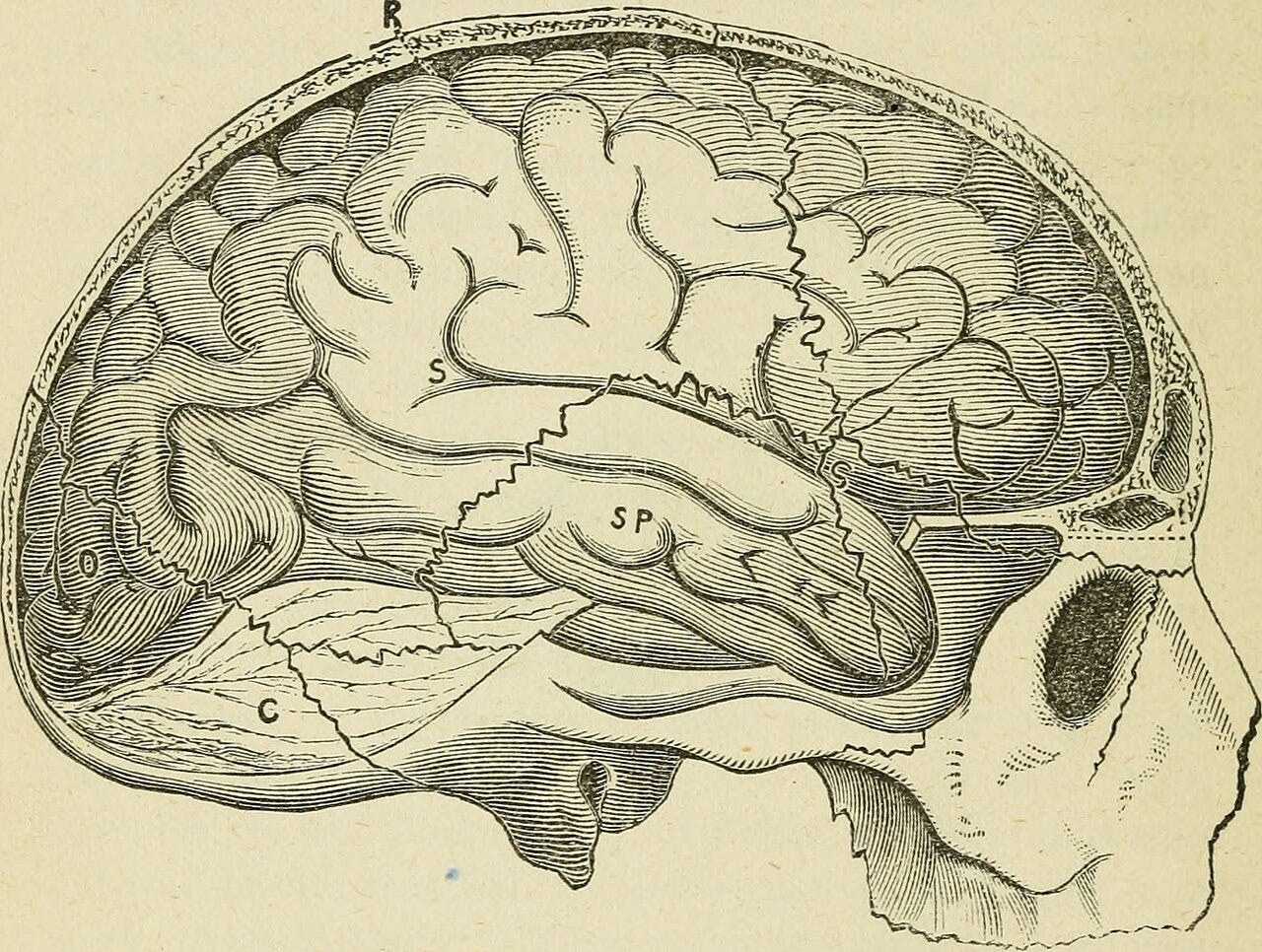
1. Art helps silence your inner critic.
Ever feel like you lose all self-consciousness when you’re creating? That's because activity in the dorsolateral prefrontal cortex decreases when you're absorbed in making art. This is where self-monitoring, personal evaluation, and the voice that asks, “Am I doing this right?” live. When it quietens, you enter that famous flow state: effortless concentration where self-judgment drops and the mind moves freely. Psychologist Mihaly Csikszentmihalyi, who spent decades studying flow, found it’s one of the most reliably satisfying human experiences. Art is a reliable trigger for it.
2. Art gives your nervous system a break.
Modern life has made stress a default state. Our brains are running on near-constant heightened alert, navigating environmental dangers—like the boss watching your screen over your shoulder or the bank balance that doesn't increase no matter how many times you refresh it. The body is always bracing for the next stressor. Engaging with creative activities can help shift the nervous system away from sympathetic nervous system activation (the fight-or-flight stress response) and toward parasympathetic nervous system activation—the physiological state associated with rest and calm.
3. Art helps you process emotions before you can explain them.
Not every feeling arrives in language. Emotions arise from more automatic layers of the brain (such as the limbic system), while formal language and logic require the higher cortical regions to translate those feelings into words. Sometimes, these areas don't align. That’s why the grief, joy, or unease that stays with you can be hard to put into words. Art is a way to frame those feelings without requiring formal language. A painting can make you cry before you understand why. The feeling is real before interpretation catches up.
4. Art connects us.
You've felt it before when you saw yourself in a favorite character from a novel, or when a painting from centuries ago makes you wonder if the artist felt the exact same ache as you. Art activates systems involved in empathy and social understanding, helping you recognize shared emotions and experiences. You aren't just a passive observer of someone else's world when it comes to art. You see a version of your own life in it, making you feel connected to the person and to the shared human experience behind it.
5. Art gives you a fun mental workout.
When you look at art, your brain isn't passively receiving information. It's working out in a fun way. The sensory-motor system has to track a figure's posture across the canvas. The emotion-valuation system decides how the piece makes you feel. The knowledge-meaning system hunts for the context in which the art was made and how it connects to you. Neuroscientists call the combined effects of these systems "The Aesthetic Triad". And with all of them working at the same time, it's no wonder art feels active even when you're sitting still.
6. Art helps turn memories into meaning.
When you encounter art, memory systems in the brain (like the hippocampus) and meaning-making systems (like the Default Mode Network) become active. A picture or a piece of music may bring back old moments, along with the emotions attached to them. That helps explain why the same drawing can feel different to different people: each viewer brings a different life to it. And art can do more than trigger memory. It can also help people reinterpret past experiences and give them new meaning.
7. Art just feels rewarding.
When an artwork creates anticipation, resolves uncertainty, or delivers a surprising pattern that suddenly makes sense, reward systems in the brain (such as the medial orbitofrontal cortex) get activated, and feel-good neurotransmitters like dopamine also get released. These are the same systems that activate when we receive a hug or try some new, delicious food.
8. Art is humanizing.
Creating and experiencing art pulls on nearly everything the brain can do at once — perception, sensation, memory, emotion, imagination, meaning-making. Art calls on all of them simultaneously, which is why it leaves behind such a layered, textured inner experience. That density is what makes it feel so deeply human.
How to cultivate a creative life (even when real life is chaotic)
Even without all the neuroscience evidence, I don't think there’s anyone in the world who would disagree that we all need a creative life.
The question is not one of desire, but one of practicality.
Creativity is up against many things for the average person living in today's busy age: Not enough time, lack of mental space, lack of energy. In other words, my life is too chaotic for creativity.
But here's a quote from Mary Shelley (author of Frankenstein) that I hope will inspire you to see that creativity comes from chaos, and not despite it:
Invention, it must be humbly admitted, does not consist in creating out of void, but out of chaos; the materials must, in the first place, be afforded: it can give form to dark, shapeless substances, but cannot bring into being the substance itself.
Mary Shelley lived a life that would count as chaotic by any era's standard, let alone in the 1800s. Her mother died days after giving birth to her. She ran away with a married man (poet Percy Bysshe Shelley, whose wife was pregnant at the time). Because of the affair, she became estranged from her father, lived as an outcast from society, faced financial hardship—and in the middle of all of it, she wrote one of the most enduring novels in English literature.
Her life never got easier. She would go on to lose three of her four children. Her husband would drown. And she kept writing anyway, because creation doesn't wait for conditions to improve. It is born from the chaos of life. From grief and love, passion and despair, hope and its absence. There is no perfect time to create, only the human impulse to turn experience into form.
Most of us are always waiting for the beautiful desk. A clear afternoon. The day we finally stop having responsibilities. Shelley is telling you that’s not how any of this works—and neuroscience agrees. The creative brain doesn’t need ideal conditions. It needs material. And your life is it.
Art matters more than ever
Our creative instinct has never mattered more. Not just for our minds, but our humanity. We’re living in a moment where the question "what does it mean to be human?” has stopped being a question reserved for philosophers. Art won't deliver us the magic answer. But it’s one of the tools we've always used to turn unanswerable questions into something we can hold.
Art doesn't happen despite the chaos of this moment. It must happen because of it.
Upgrade to premium to access all paid content where we explore how to Think Human in an AI world (includes the Romanticize Your Intellectual Life series).
Everything. Everything in our society/culture fights every element of art and its importance tooth and nail. Productivity is the “goal” and when I finally was able to “stop being a productive human” it took a long arsed time to lose the “must, should, ought” that poisons our souls (yes, we gots ‘em, still) and made my art want to be perfect etc., etc., and on a schedule, and and and… hooooey. Good luck making art, right? That was my thinking, too. Now I approach it from the child in me aspect. I have fun. It’s just like reading a book. Taking a walk. Making a nice lunch. Once I allowed it that freedom, then it became all of the things in the above article. Hmmm. And then some, even…. Thank you for such an informative article!
With Love,
An Unproductive Human 🥰
Love this. My issue is that when life gets busy, my creative projects are the first thing to hit the back burner. This is a great reminder to prioritize them, and a big takeaway for me is that any contribution to art (even 10 minutes a day) is better than none!