
Romanticize your intellectual life (Fall in love with your mind again)
A 5-week guide to recover from mental numbness and brain rot. Rediscover the beauty of your mind and fall in love with ideas again.
Can a mind be active but feel dead at the same time?
That is the question that confronted me at 9 PM one night. The kids were finally asleep. It was my "me” time. I opened my phone for the bedtime scroll, and somewhere between news updates, YouTube videos on “10x-ing my income,” and a book summary on habits, the realization hit:
I was consuming all this information, but the ideas were dead to me. Like my mind has been zombified.
From the motivational social media quotes to the funny viral clips, and even the useful productivity stuff… None of it spoke to me at a deeper level anymore. Even my own thoughts started to feel like someone else's. When an idea would float across my mind, I'd second-guess myself. Was that really me? Or am I subconsciously rewording something I read on social media or an AI chat?
We talk about this problem in terms of “improving content quality” or “shortening attention spans.” But the issue runs deeper than that.
We've forgotten how to treat our minds like a living organ.

The productivity→”junk recharge” trap
How did we all get to this state? It's because we treat our minds like a machine that only has two modes: Productivity and “junk recharging”.
Productivity is the mode where your mind is used. This is the world of work, meetings, deliverables, and output. You're thinking, but it's always in response to the day's demands—whether it's running a startup or catching up on the latest AI news to improve your workflow.
Then, there is the mode where your mind is numbed. You fill it with “junk recharging,” like a Netflix queue, the infinite scroll, and quick-hit YouTube Shorts. You call this “rest”, but it's just suspending your consciousness until the machine has to start up again.
Work. Recover just enough from work. Work again.
It’s not that any of these things are bad. We need work and productivity. And some mindless amusement isn’t going to automatically reduce your IQ score.
But if this endless loop is all there is for your mind, you lose something far more important than intelligence:
You forget that your mind is meant to be a garden of beautiful ideas.
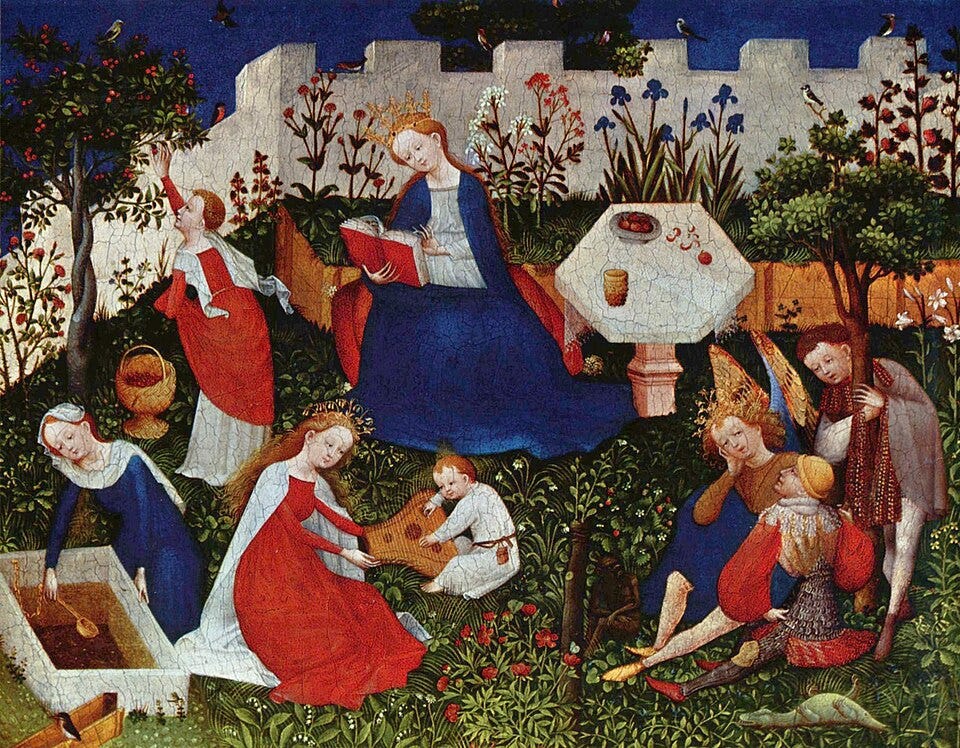
Your mind's forgotten space: The Walled Garden
In the medieval period, the walled garden (hortus conclusus) was a kind of practical sanctuary. Protected from the harsh elements and animals, it was a safe space for herbs and vegetables to grow. But it also served as a beautiful place of peaceful contemplation.
Your mind is meant to have a space that emulates this architecture. A private interior world that's peaceful, protected, and filled unique ideas that delight you. In the garden, you don’t go to be productive. You go to be present. You plant seeds of ideas you love—whether it's Gothic literature or algal blooms—and slowly tend to them until they bear fruit.
But somewhere along the way, you simply stopped going there. That’s when something else moved in.
The algorithm. The hot takes. The endless stream of packaged ideas. All picked, processed, and handed to you pre-consumed. The garden didn’t disappear. It just got filled with everything you never chose, your own inner world suddenly became unrecognizable.
Your mind isn’t broken; you’ve just forgotten it was ever a garden.
How to grow your walled garden again?
Here’s the thing about your walled garden. You can’t force it back to life. You can’t optimize it, hack it, or productivity-system your way back to a mind that feels alive. Because a garden doesn’t respond to force. It responds to love.
Think about what tending a physical garden actually requires. You curate a selection of your favorite plants. Then you show up and patiently give it what it needs day after day with no guarantee of any flowers or fruits. There’s no demanding anything from it. The joy is in the process of tending to a living thing with love rather than extracting utility from it.
This is why romanticizing your intellectual life is the answer.
It means approaching thinking, learning, and ideas with a sense of wonder, passion, and aesthetic pleasure—rather than treating them purely as means to practical ends.
It’s enjoying the slow unfolding of a complex idea as you wrestle with it for days just for the joy of understanding it. It’s the resonance you feel when a poem from four centuries ago describes the exact shade of sadness you’re feeling.
Unfortuantely, thinking has become primarily instrumental these days. We engage with ideas to extract something from it in the shortest amount of time, whether it’s a framework, a fact, a “key takeaway.” Our relationship with thinking has become purely transactional.
When you romanticize your intellectual life, you won’t find a “smarter”, “better”, or “more productive” way of relating to your mind. You’ll find something even better—a more human way of thinking, where you relate to your mind as the living thing it actually is.
It brings to your walled garden exactly what it requires for beautiful ideas to take root: patience, curiosity, and the aesthetic sensibility to know what belongs there.
Once you start doing this, living inside your head starts to feel enchanting. It’s no longer simply a tool for productivity or a reserve of anxieties. It becomes your daily destination of wonder and contemplation you look forward to.
To fall in love with your intellectual life again, you don’t need a new app or a longer book list. You need a new relationship with your own thoughts.
And lucky for us, the great thinkers of the past have already shared their wisdom on growing the walled garden. The tension you feel between productivity and pause isn’t new, and neither is the way out of it.
Your 5-week mind recovery: How to romanticize your intellectual life
Over the next five weeks, I’ll be uncovering this lost wisdom from the people who’ve already worked past this same struggle. From the classical Greek philosophers to the thinkers of the Romantic period.
We aren’t going to consume more abstract philosophy. This is about the practice of relating your mind in a new way.
If you’re tired of living in a mind that feels flat, distracted, or borrowed… this is your way back.
Unlock Week 1 below. Make your mind feel alive again.
Here’s the road map starting 12 April:
Week 1: Turn your mind into a thinking sanctuary
Build the walls of your garden and create a protected space for contemplation, away from the noise of productivity and the algorithm
Week 2: How to get lost in a book again
Bring the right type of attention to your garden so ideas come alive.
Week 3: Cultivate your unique intellectual taste
Plant the right seeds and start growing a garden of ideas unique to you (not just algorithmically-determined ones).
Week 4: Think originally and create joyfully again
Help your plants bear the fruit of original insights, connections, and perspectives.
Week 5: Make this a permanent relationship with your mind
Turn romanticizing your intellectual life from a five-week experiment into a daily ritual that changes how you think forever
If you've been feeling numb, distracted, or empty…this is your way back.
Your mind isn't broken. You've just forgotten how to treat it like a living garden for beautiful ideas.
Unlock Week 1 by upgrading to premium.
The love we had for the mind was severed long ago.
We need to bring it back and deepen our sensuality with it.
https://athanatospneuma.substack.com/p/the-neville-goddard-method-2-awakened?utm_campaign=post-expanded-share&utm_medium=web